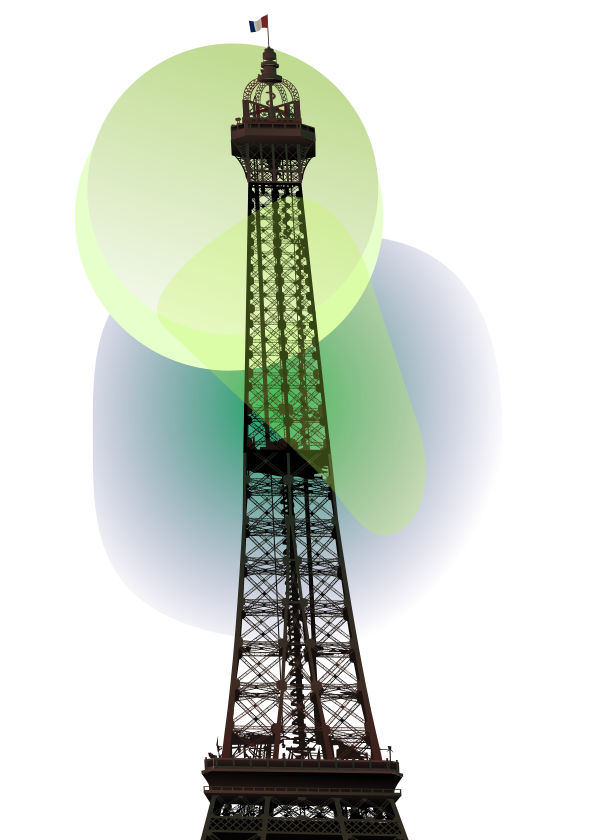
The Eiffel Tower
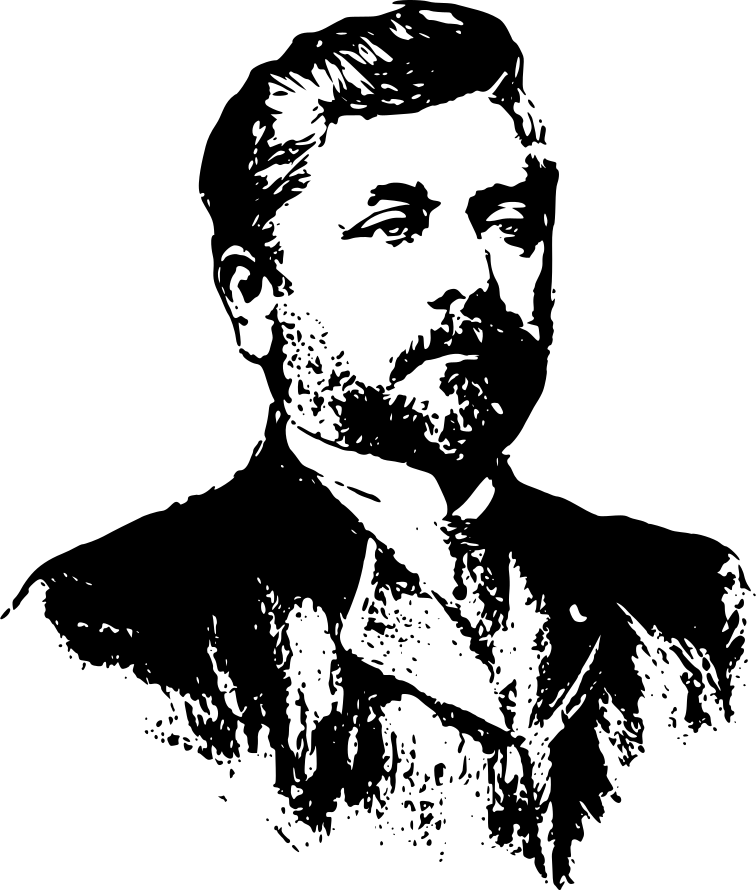
Mr. Gustave Eiffel
An indomitable spirit, a tenacious will, and unwavering determination form the foundation of the distinguished engineer who attached his name to the 300-meter tower, a name now known throughout the world, even in the most remote villages; perhaps even more widely known than any name promoted by politics.
In addition to this,Mr. EiffelHe is a kind, gentle man, with a certain shyness in his relationships.
Mr. Gustave EiffelHe had valiant collaborators: his son-in-law, Mr. Adolphe Salles, an engineer;Mr. Émile NouguierandMr. Maurice Koechlin, ingénieurs de sa maison, et Mr. Stephen SauvestreArchitect.
Adopted from the outset by public opinion,Mr. EiffelHe overcame the obstacles that invariably arise in the realization of ambitious designs, created to inspire envy.
Established on March 31, 1889Mr. Gustave EiffelHe was able to plant the French flag himself on this unparalleled monument, the tallest ever created by human hands.

The origins of the Tower
The initial idea dates back to 1875, when the organizers of the Philadelphia Exposition proposed building a tower 1,000 feet high. However, this project was immediately abandoned. The idea was revived in 1880. At that time, the plan was to illuminate public roads using powerful electric lamps placed at a great height. In Denver, pylons of 82 meters each supported four electric lamps that illuminated the entire city. By the end of 1881, a French engineer, M. Sébillot, proposed illuminating all of Paris using a single lamp placed on a 300-meter tower. Sébillot's idea interested M. J. Bourdais, the architect of the Trocadéro Palace, and these daring innovators worked together on a highly detailed project, the details of which were presented to the Société des ingénieurs civils on January 23, 1885, and for which a patent was taken out on May 6, 1882.


In the late months of 1888, an engineer, Mr. E. Nouguier, studied a new design, with particular attention paid to resolving the construction difficulties of a 300-meter tower.
Presented to M. Eiffel, who had already distinguished himself with his high-span bridge designs, the young engineer's project initially did not appeal to him, and he almost rejected it outright. Shortly thereafter, M. Eiffel adopted this preliminary design and made it his own, and he tasked M. Kœchlin, the engineer, and M. Souvestre, the architect, with, in collaboration with M. Nouguier, preparing a definitive project and cost estimate.
Opening of the Eiffel Tower
Monograph
Today,May 15, 1889Six weeks after reaching its intended height of 300 meters, the Eiffel Tower opens its staircases to the public, pending the operation of the elevators.A cette occasion le Official Bulletin se croit dans l'obligation de publier la monographie suivante :

Artists had formed a coalition to protest against her on behalf of art. Were they unaware that immensity is also a form of beauty? This Tower, more than any other monument, conveys the impression of strength. It is perfectly suited to a museum, as it is the masterpiece of the constructor's art. It arrives at the turn of the 20th century, to symbolize the age of iron that we are entering.
On the second floor, and especially on the highest platform, one discovers a landscape that the human eye has never seen before. It is from this vantage point that one can best contemplate the passage of centuries. Nature and history unfold before you in their most powerful forms. It is on this vast plain beneath your feet that all of the past comes to fruition. It is here that the future will unfold.
We have placed this concise and insightful appreciation of one of the greatest thinkers of this century at the beginning of this guide. What could have been more precise, more impactful, and more truthful than these few excerpts from a recent article by…Mr. Jules Simon ?
Chronicle of the opening to the public
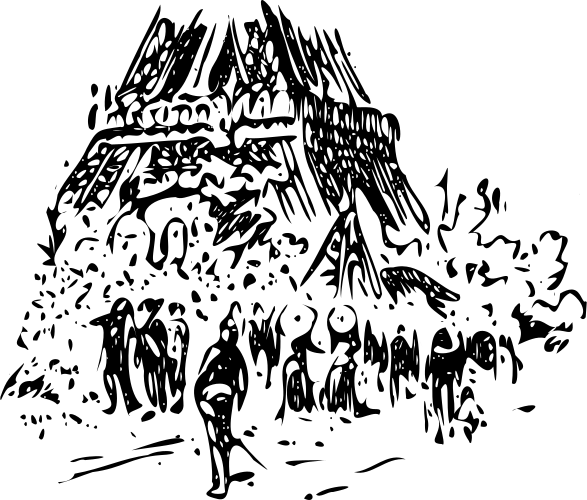
She had opened her doors, and the first visitors were able to climb the West tower staircase around eleven in the morning.
A stylish chalet, located at the base of each tower, is assigned to the distribution of tickets.
The staircase was renovated from bottom to top. The steps are made of large oak planks. It should be noted that the original steps had been literally worn down by the passage of workers from the Tower.
The ascent of the first floor via the staircase (318 steps) can be accomplished in three or four minutes with a bit of effort in the calves. It will take five or six minutes if you ascend slowly.
First floor
On the first floor, we are at the final stage of installation. The galleries and terraces have been cleared. I made my inspection in the morning, to assess the situation before the public arrived. I found the restaurants in the final stages of completion.The waitresses were having their meals so they could be ready at the appropriate time. Chairs, tables, and counters were being set up all over the place. The stoves were lit, and the smell of the kitchen was already making people hungry.
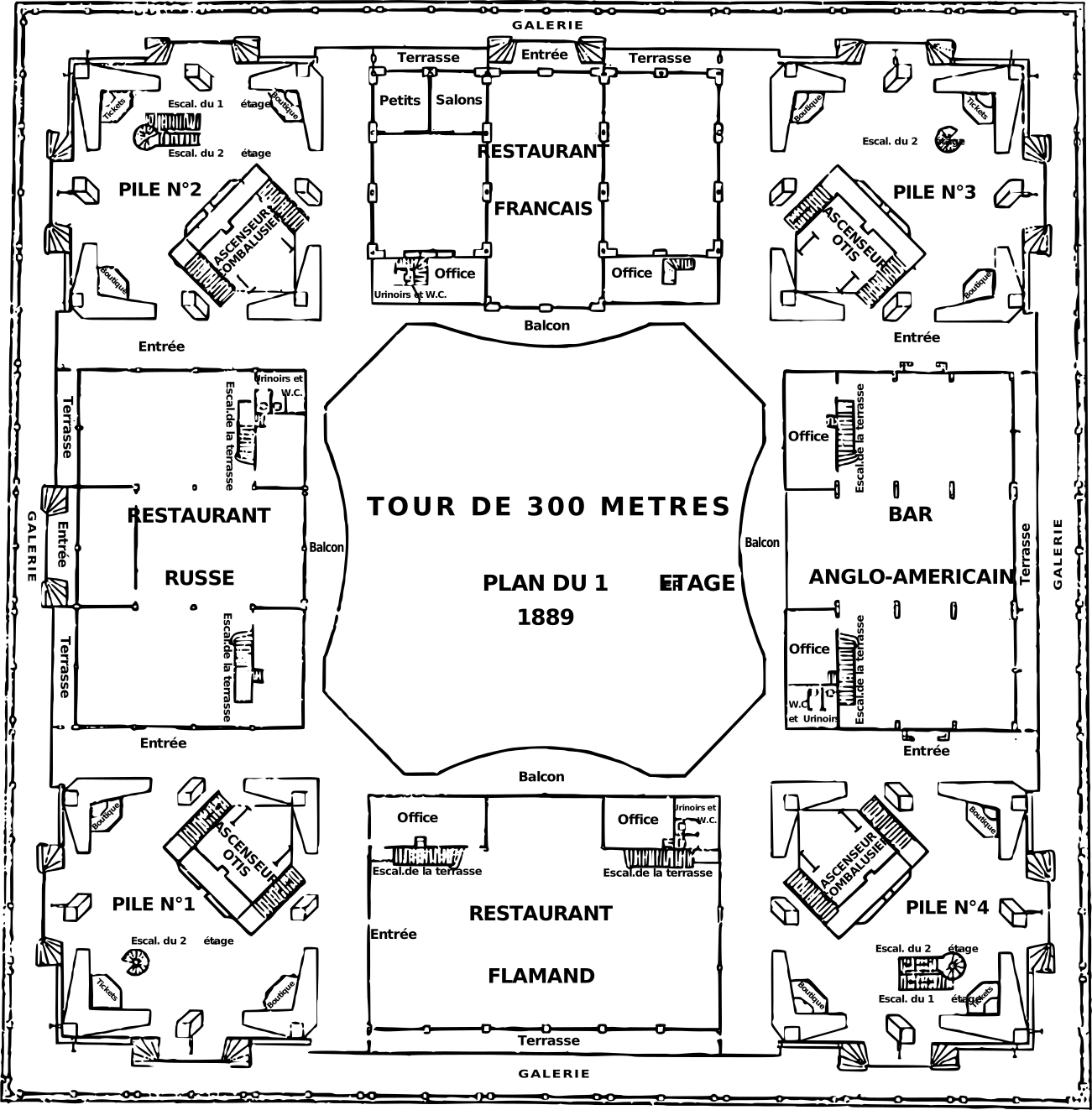
It consists of two large living rooms, a small living room, and two rooms where you can have dinner for 8 to 10 people. The Louis XV style was chosen for theFrench restaurantAnd I must also commend the very successful landscaping. The outdoor terraces offer views of the Exposition gardens. The view is magnificent.
The restaurant facing the Trocadéro was supposed to be a Flemish restaurant. It is, and no one will complain, now a restaurant serving...Alsace-Lorraine, from the coffee-restaurant chain. It is managed by Mr. Boll. The beer served there comes from the brewery of theCross of LorraineIn Bar-le-Duc, seven women are serving, wearing the Alsatian costume; seven others are wearing the Lorraine costume.
The Russian restaurant, a jewel of Moscow architecture and décor, faces Paris. It consists of a large hall in which a separate bar, open onto galleries, has been created. Women in Russian costumes serve customers at the bar.
This restaurant was opened to the public today. It is operated by Mr. Raffestin.
The restaurantAnglo-American, facing Grenelle, forms a single, vast space; plus the outdoor terraces. Its decor is so fresh that it refreshes the eyes, before the drinks refresh the visitors. The view from the restaurant terraceAnglo-AmericanIt stretches across Grenelle, along the Seine, and up to Mont Valérien. It is operated by Messrs. Spiers and Pound.
We were beginning the installation of the shops and kiosks for selling tickets, guides, and photographs. They are very elegant.
Second floor
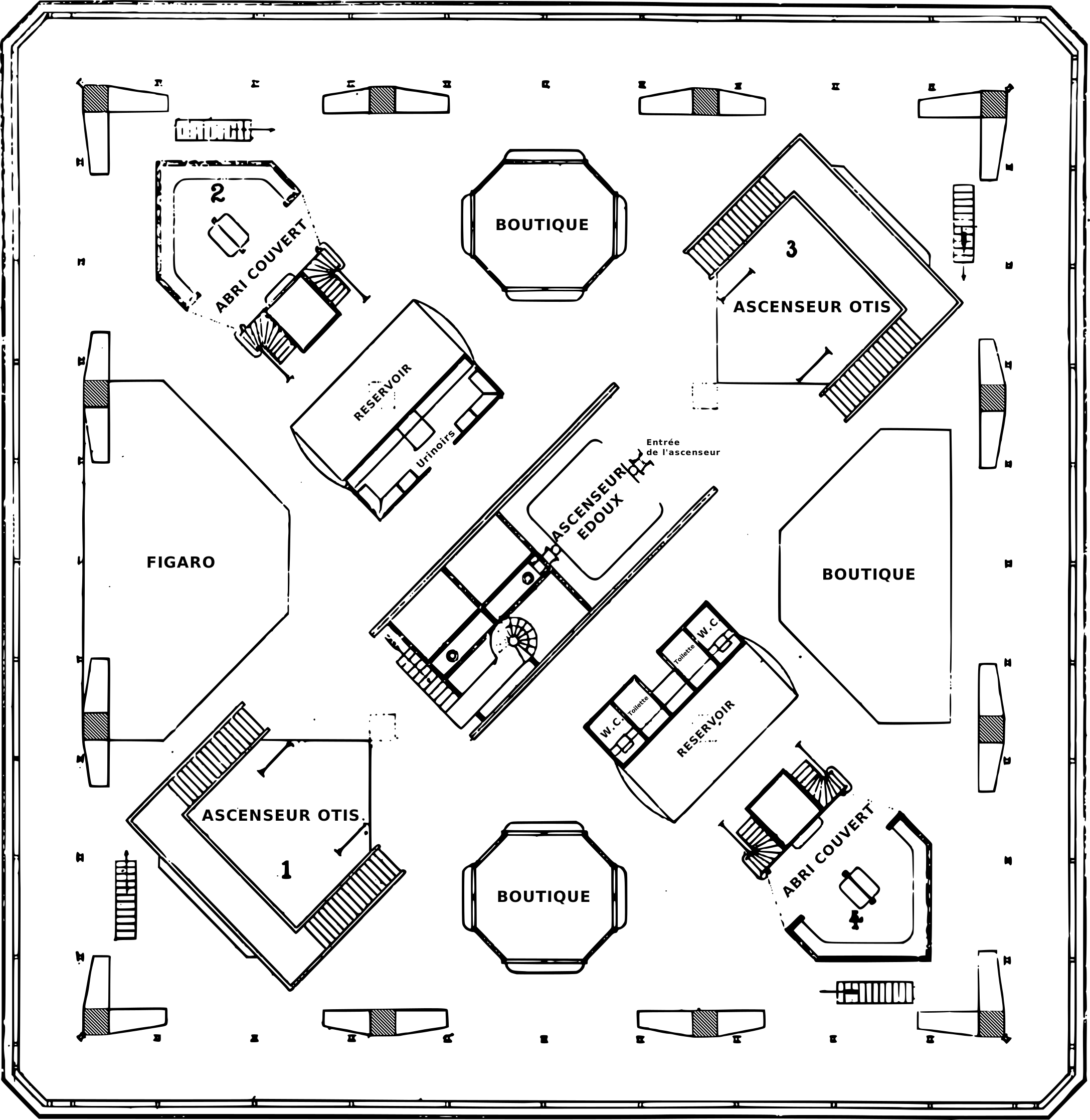
With them, I climbed the spiral staircase to the second floor, and we went straight to the printing shop.Figaro. Cette imprimerie mignonne est fort bien installée. Une charmante petite presse rotative commençait à rouler et le FigaroDe la Tour was first seen from the Champ de Mars, rising 115 meters above ground level.
My colleagues were in position. Périvier was in command of the maneuver; Bonnetain was holding the steering wheel.chronicle; Beer et de Castelane à leur place de bataille. Tout autour d'eux, une équipe complète, vaillante et assidue : metteur en pages, compositeurs, etc.
TheFigarode la Tour and theOfficial Bulletinare the only two newspapers produced on-site.
ToFigaro, the kingdom of heaven!
ToNewsletter, this is the land from which I write these words.
If I were to commit any of these foolish acts that could jeopardize my place in heaven, I would pray to Périllier, Bonnetain, Berr, and de Castellane to intercede for me: as they are closer to heaven than I am.
The tower, in detail
This wonderful tower is also an exposed bridge structure on the Champ de Mars. From this perspective, it marked the beginning of a revolution in the art of constructing bridges and viaducts designed to cross deep valleys and ravines, which were previously considered impassable. Until then, it was barely conceivable to design bridge structures with heights of over 120 to 130 meters.
Mr. EiffelIt has been demonstrated that it can be used to cross distances of 300 meters. Moving forward, railway lines will no longer need to make enormous detours to circumvent valleys ranging from 200 to 300 meters in depth, and travel times will be reduced.
Foundations

The Champ de Mars is partly owned by the State and partly by the City of Paris. The land on which the concession was granted is owned by the City.Mr. EiffelFor a period of twenty years; the site occupied by the Tower is the middle of the park created in 1878, completed in 1889.
The tower is located along the axis of the Champ de Mars, and, as this area is inclined at 45 degrees on the meridian, it follows that the four pillars of the tower are precisely located at the four cardinal points. The two pillars facing the Seine areNorthandWest, celles en arrière sont EastandSouthTherefore, the piles have been given the names of the cardinal directions.
The foundations for the two rear piles are built on a 2-meter concrete platform that rests on a layer of gravel and sand more than 5 meters thick. The foundations for the forward piles, towards the Seine, are constructed using four 15-meter long, 6-meter wide steel caissons, which are driven down to a depth of 5 meters below the Seine level. The foundations are perfect.
Each of the four iron columns in each pile transmits obliquely its share of the load from the supported mass, which rises to 565 tonnes without the additional pressure that can be added by wind, and 875 tonnes with wind, distributed over 90 square meters in piles 2 and 3, resulting in a load of 3.7 kilograms per square centimeter. Furthermore, due to the smaller depth in piles 1 and 2, caused by the foundation caissons, the load is only 3.3 kilograms per square centimeter.
Finally, we have decided to complete the renovation of the fountain of Mr. de Saint-Vidai, which is located beneath the Eiffel Tower.
The plumbers are finishing the installation of zinc sheets over the basins located between the seated statues: the water jets in the central area will then be able to function, and the effect will be very impressive.
Stone-built foundationsChâteau Landonare capable of withstanding a compressive force of 1.235 kilograms per square centimeter. And the pressure under the cast iron pads that support the Tower's edges is only 30 kilograms per square centimeter. Therefore, the stone of the foundations only experiences one-fortieth of its compressive strength.
Il n'y a donc aucun doute à concevoir sur la solidité des fondations. Les fondations proprement dites sont noyées dans un remblai arrasé au niveau du sol. La base massive qui apparaît sous forme de rocaille et de soubassement n'est qu'un habillage. La rocaille est composée par des massifs de maçonnerie pittoresquement arrangés, entre lesquels poussent des fleurs et des arbustes. Si bien que chaque pile à l'air d'être placée sur un énorme rocher émergeant du sol. Le soubassement décoratif, vertical d'habord, puis suivant l'inclinaison de la pile, est constitué par des dalles en béton Coignet, enhanced by a series of recessed drawings.
Since we are still in the foundation stage, we must state that the foundations for pillar number 3 (south) are at the level of a basement intended for housing the machinery and their generators. This machinery room is connected to a tower that rises behind the Brazil Palace, on the other side of the lake, via a channel. This picturesque tower is the chimney of the machinery room of pillar number 3.
The foundations, which were attacked on January 28, 1887, and completed on June 30 of the same year, involved the excavation of 31,000 cubic meters and the use of 12,000 cubic meters of masonry.
The metal part

The construction of the Eiffel Tower's metal framework was a marvel of precision. It represented the pinnacle of engineering artistry. With no on-site construction, the pieces arrived ready to be assembled, eliminating the need for extensive on-site modifications. This resulted in the drilling of millions of rivet and bolt holes in the workshops.Levalloisand that its small, mobile work areas, which rose with the building, were able to fabricate, assemble, and bolt components as they arrived on site, using mobile and ascending cranes. This level of precision was the subject of admiration among all skilled professionals.
The atmospheric electricity received by this iron mass flows into the ground, through each pile, via two 50-centimeter diameter pipes, which are submerged up to 18 meters below the water table.
Therefore, the lower section of the Eiffel Tower consists of four inclined pillars, which are joined at a height of 55 meters by beams of 7.50 meters, forming the rigid and fixed base on which the tower itself is built. The space occupied by the four pillars is more than one hectare, as the distance between the axes of one pillar (at its base) and the axis of another pillar is 100 meters.
This initial section of the monument, which has been unfairly judged by those who lack the patience to wait for its completion, will remain a monument that is both grand and elegant, and has been so since it was fully adorned.
Are these four enormous arches not wonderful frames that frame the magnificent buildings without harming their proportions, just as a large frame does not detract from a detail in a painting? Quite the opposite, these frames enhance the buildings. They are as large as the framed subjects, and that is all.
First-floor gallery

Above, all around, the gallery or promenade is entirely composed of a succession of graceful arched loggias, each base adorned with magnificent bronze cornices. The arches of these loggias are in a fan-like grid pattern, with lines originating from a small column. The vertical spaces between the loggias are open, with golden-colored crystal cabochons. Behind each cabochon is a gas fitting. This will result in a multitude of sparkling columns on illuminated days. During these days, the lines of fire will follow the main lines of the monument, revealing the artistic value of this cyclopean design.
The second floor and elevators
Therefore, there will be elevators and stairs to reach the second floor, and only one elevator to go from the second floor to the top. Let's start with the stairs. In the east (building no. 2) and west (building no. 4) sections, there are solid oak stairs, recently renovated in preparation for the exhibition, measuring 1 meter wide. There are 318 steps to reach the first floor. The stairs in building no. 4 are used for ascending, while the stairs in building no. 2 are for descending. These stairs are very smooth, with numerous steps.The ascent is not at all tiring. 2,000 people can use this route, per hour, without congestion. Of the four staircases between the first and second floors, two are designated for public use, one for ascending and one for descending. These are also the staircases on the north and south sides. These staircases are helical, with a width of 0.60 meters.
Au moment où nous mettons sous presse, nous apprenons que Mr. EdisonIt is located in the living room of the apartment.Mr. EiffelAbove the third platform.
In the absence of the Tower's builder, it was Mr. Sales, an engineer and the husband of Mr. Eiffel, who gave the famous electrician of the New World a tour of the 300-meter tower.
Mr. Edisonwas greeted upon arrival by Mr. Thomas, Deputy Director, and Mr. Ansaloni, Director of Operations. A concert was organized in his honor in the apartment of Mr. Eiffel, at the top of the Tower.
This concert will be recorded using Edison's phonographs and then sent to New York, where it will be reproduced phonographically.
It is Mr. Lion from the Pleyel house who will be attending.Mr. EdisonIn its operations related to the reception of musical and audio recordings.
These devices are reportedly so advanced that they can be replicated nearly 22,000 times. WhileMr. Edison se trouve sur la Tour on y voit monter quarante Indiens de la troupe de Buffalo Bill, carried out under the direction of one of their leaders.
There will be three types of elevators, from the base to the top.

There are four elevators to reach the first floor, including two for public use. From the first to the second floor, the Otis system was used, with a hydraulic piston operating a large cage. The operator would ride up to the second floor on a pulley system, then descend to attach to the cage.
As a result, if the piston of the 11-meter cylinder, located at the base of the tower, is moved 1 meter, the cabin will rise or descend by 12 meters.
The counterweight moves by rolling beneath the elevator track. The six cables that support the cabin, two of which are connected to the counterweight, and four belong to the geared pulley system, are made of steel wire. Only one of these cables would be sufficient to support the cabin and its occupants without breaking. In addition, a safety brake has been added. The counterweight is also equipped with a safety device, making its fall impossible.
The Otis-manufactured elevator car only accommodates 50 passengers instead of 100; however, its speed being double that of other systems will result in the same passenger throughput per hour.

Nous avons dit que le plancher intermédiaire était le point de départ des deux cabines. Lorsque la cabine supérieure monte, la cabine à course inférieure, qui lui sert de contrepoids, descend tout naturellement. Il s'ensuit que pour pàrcourir le trajet de 160 mètres, il y a une station au plancher intermédiaire, comme dans un chemin de fer. Chaque cabine parcourant la moitié de sa course, il y a échange de voyageurs sur le plancher intermédiaire, sans le moindre encombrement, les « montants » passant par une autre porte que les « descendants », sans perte de temps non plus. Il faut 1 minute 1/2 pour arriver au plancher intermédiaire, 1 minute pour le passage d'une cabine à l'autre, et 1 minute 1/2 pour la course supérieure. Elle est reliée par des câbles à une seconde cabine qui forme contrepoids, qui voyage entre le deuxième étage et le plancher intermédiaire, soit 80 mètres en sens contraire. Total pour les deux, 160 mètres. De la partie supérieure de la première cabine et des deux extrémités du palonnier, partent quatre câbles qui, passant sur des poulies placées au sommet de la Tour, soutiennent la deuxième cabine. Deux des câbles s'attachent sur un palonnier au milieu duquel est suspendu cette cabine, les deux autres câbles sont fixés au corps de la cabine même. Ces cabines ont 14 mètres carrés et peuvent contenir 63 personnes environ et élèvent environ 750 personnes à l'heure.
One of our colleagues is doing atMr. Eiffela prayer to which we eagerly join. It is to forbid our soldiers from engaging in the dangerous exercises they practice each evening below the first platform, at the time the gas lamps are lit. Instead of walking along the promenades, like everyone else, and lighting their lamps with a particular type of pole, these brave men, with a truly reckless courage, walk along the promenade on a ledge a few centimeters high, directly over the abyss. And since this terrifying spectacle causes the women who walk in the Tower to cry out, the proud soldiers stop... and light a cigarette above the abyss, where even the slightest movement could send them plummeting.
The total ascent time, from the bottom to the top, using the elevators, is 7 minutes.

With the stairs, it can be said that 5,000 people can visit the Eiffel Tower every hour.
Staying in the Tower is optional. Can you imagine the number of people the Tower can accommodate when it has reached its maximum capacity of visitors?
No, isn't that right?
Well, do the math.
| Chacun des restaurants du premier étage, 400, soit pour les quatre | 1.600 |
| Approximately 1,000 people can move freely through each of the four exterior galleries. | 4.000 |
| Between the restaurants, there will be interior courtyards that can accommodate multiple spaces. | 400 |
| Total for the first floor. | 6.000 |
| We will have 1,500 people on the second floor and 500 on the top floor, all together. | 2.000 |
| Les personnes en voie d'ascension, plus les gens de service peuvent s'évaluer à | 2.000 |
| And you will have, when the tower is full of visitors, a total of approximately | 10.000 |
Ten thousand people in this iron cage; what a beehive! What a hum! What life! A city in a tube. Perpetual motion. And to think that days of chaos, such as Sundays, could last from 10 am to 11 pm.
| Key dates of the Eiffel Tower | |
| Beginning of construction | January 28, 1887 |
| Inauguration and end of construction party | March 31, 1889 |
| Open to the public | May 15, 1889 |