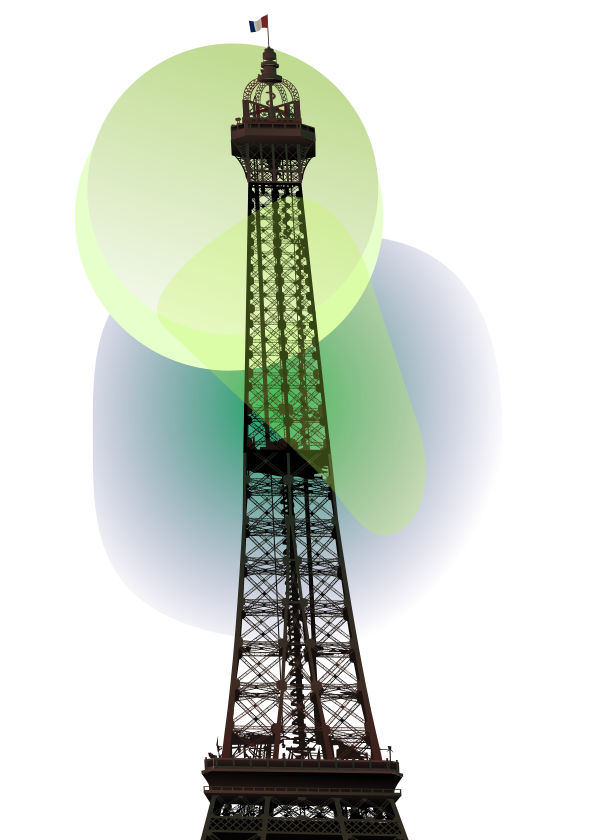
The 1889 Paris World's Fair
Implementation

Finally,Mr. Edouard LockroyIt advocated for the organization's continued status as a state-run entity and the company's responsibility. It argued that it was of paramount importance to hold the Exposition in Paris itself, and it chose the Champ de Mars, along with the Trocadéro and all its dependencies, once again, due to its proximity and ease of access. It also added the Esplanade des Invalides, the entire length of the Quai d'Orsay, with the Seine's banks, in order to create a sufficiently large and cohesive ensemble.
On April 3, 1886, the Minister of Commerce presented a bill to the Chambers of Deputies in this regard; and, three months later, on July 6, the law creating the Exposition appeared in the Official Journal. The State, the City of Paris, and a Guarantee Society, composed of the most important figures in finance, industry, and commerce, participated, in a predetermined proportion, in the financial organization, whose expenditure budget was estimated at 43 million francs.
On July 28, the Minister, as a general commissioner, issued an order appointing three general directors to head the Exhibition: Mr. Alphand, for operations; Mr. Georges Berger, for management; and Mr. Grison, for finance.



At the same time, the project for a 300-meter tower, designed by M. Eiffel, was also approved, although it was initially very controversial and heavily criticized, particularly by some artists.Mr. Lockroy, in accordance with the overwhelming support of the public, was firmly supported and ultimately passed.
Those who, like us, have witnessed, day after day, the birth and creation of the work that President of the Republic must present to France and the world on May 6th, can alone appreciate the immense effort, talent, activity, and energy that has been expended to produce this wonderful and gigantic exhibition, which constitutes the most magnificent exhibition ever offered to the curiosity and admiration of the world.

The exhibition prior to opening
Today, the work that began three years ago, under such unfavorable circumstances, is almost complete, and it can be said that the result has exceeded all expectations.
The grand exhibition halls stand imposingly and magnificently in the middle of the Champ de Mars: the Machinery Hall, with its prodigious 115-meter-high structures, so ingeniously designed and executed by Mr. Contamin, will amaze and move you, just as the Eiffel Tower does; the Hall of Various Industries, with its superb dome and fairytale-like entrance galleries, facing the gardens; and the Hall of Fine Arts and Liberal Arts, so brilliant, so cheerful, with a truly original and artistic character.
Despite all the ridicule, and despite the strikes and unfavorable circumstances, the Eiffel Tower has mathematically reached its three hundred meters, as planned by its eminent inventor.
The gardens and parks are dotted with a multitude of structures: special exhibitions, such as those by watercolor and pastel artists; pavilions representing the United States, some charming and elegant, such as those of Bolivia and the Argentine Republic, while others are more austere, such as that of Mexico; the Grand Theatre of the Exposition (Palais des Enfants), whose construction, full of grace and elegance, pays tribute to the skilled architect, Mr. Ulmann; the Theatre des Folies - Parisiennes, and others, including the pavilion of.Official Bulletin.

We were very impressed by the miniature trees displayed by the Japanese horticulturists. These include thuja, pine, and cedar trees that are 100 and 150 years old and do not exceed a height of 50 centimeters.
Thus, one can have small forests in flower pots and weeping willow groves on a bedside table. We wondered how the Japanese managed to produce these unusual plant formations: through patience and careful work. Each branch that grows is laid on the ground and held in that position using stakes and ties. The curvature is quite pronounced, affecting the shape of a right angle; the upper part of the branch continues to grow while the other withers and dies. Whenever a new shoot appears, it is treated in the same way. By suppressing the growth of the vegetation and forcing the shrub to take the most convoluted shape possible, we are able to produce these surprising, deformed plants.
This work must be continued by several generations of horticulturalists, as it can last for 150 years or more.
Is the result aesthetically pleasing? That's a matter of personal preference. All we can say is that the sight of these dwarf trees immediately explains the strange and tormented shapes of the plants that the Japanese reproduce on their lacquer plates, in their bronzes, and in their embroidery.
At the Esplanade of the Invalides, there are finally the palaces of the Protectorate countries, the Palace of Algeria, and the Tunisian Exhibition Palace, with its tireless Resident General in Tunis.M. Massicault, took the initiative to personally oversee the final works; the pavilions of Tonkin, Annam, Cochinchina, and Cambodia; the Ministry of War's palace, the Castellani panorama, and the Gastronomic Pavilion, all present the visitor with a sense of wonder at the bizarre and picturesque nature of their construction, and give them the impression of a Thousand and One Nights palace suddenly appearing on the face of the rigid and imposing Invalides Hotel.

As soon as a relative calm had settled in for lunchtime, the crowds rushed into the restaurants, many of which had been open for over a month; while others were now competing for the business of exhibitors, waiting for the provincial and foreign customers. With just a few more days, this enormous complex of buildings and palaces will be completed, andMr. Carnotcan declare that the 1889 World's Fair is open.
The inauguration
Therefore, the first phase of the preparations has now begun, which has been underway for several months. In just eight days, remarkable progress has been made: the exhibition halls, which were previously empty, are now fully occupied, and the display cases, which had been waiting for their exhibits, are almost everywhere filled; there are still a few stragglers, but everyone will be ready in about ten days.
This industrial complex is also very well organized; the central wing, parallel to the machine hall, is reserved for French sections, and the two flanking wings along the garden are reserved for foreign sections.

We leave the Palais des industries diverses to head for the Palais des machines. We will not discuss this admirable iron vault, a masterpiece of boldness and power, under which the Vendôme column could stand without the statue crowning it touching the top.
We have described it, and one of our colleagues responsible for technical matters will dedicate several articles to this remarkable achievement of our engineers' science. I am simply noting the impression I experienced while traversing this forest of machines, which represent the latest advances in mechanical science. It is inspiring to see that even the simplest tool in creation has been able to forge such powerful instruments and formidable machines.
Il y a là une masse d'acier en mouvement qui provoque comme une sorte de vertige et qui, sous les feux de la lumière électrique, prendra l'aspect fantastique d'un colossal décor de féérie.

We arrive at the Eiffel Tower, which, between its four monumental pillars, houses a garden with the beautiful Saint-Vidal fountain, and which would be considered a park by the local castle owners in the Paris area.
Human clusters fill the tower's staircases, as the elevators are not yet complete; we arrive at the first floor, a veritable city, with restaurants full of visitors, and a circular gallery offering a magnificent view: the human column, resembling a serpent, stretches to the second floor.
I leave the Eiffel Tower and head towards the Champ de Mars, on the side of Avenue de Suffren; the pavilions of the American republics are close together, a profusion of colors and flags, decorations and domes, turrets and bell towers.
J'arrive au Children's Palace où se trouve le grand théâtre de l'Exposition; une salle fraîche, du rose et du bleu; les contes de Perrault en médaillon, des peintures de clowns et de danseuses, le Petit Poucet et Barbe-Bleue, l'Ogre et Peau d'Ane. On joue des pantomimes, on représente des ballets, l'excellent chef d'orchestre, Artus, est là, au pupitre. A côté le Pavillon de la mer, avec ses bateaux en mouvement et le Musée japonais une des plus curieuses reconstitutions de la vie japonaise.
I am walking across the Champ de Mars and heading towards the avenue de La Bourdonnais; the Théâtre des Folies-Parisiennes is putting on a brilliant performance, a ballet; I then walk to the Quai d'Orsay, where the rue de l'Habitation showcases its original buildings, in which merchants from all countries are producing local goods.
I step onto the Iéna Bridge, and I find myself in the Trocadéro gardens, a true symphony of colors. All the richness of the flora, all the specimens of arboriculture, are gathered here. It is civilized countryside brought to the heart of Paris; it is nature perfected by human hands.

I leave her until tomorrow, with the indelible impression of a dream, full of seduction that will continue for six months.
A Sunday at the exhibition
The exhibition will undoubtedly see many Sundays like yesterday; but nonetheless, yesterday's day will remain unforgettable! Attendance reached 234,727. It should be noted that the weather was favorable, neither too hot nor too cold, with a few light showers that fell at just the right time to clear the dust and brighten the greenery of the gardens; and, of course, the crowds of workers, merchants, and small employees – and this is the true Sunday audience, who rushed to the Champ de Mars and the Esplanade in a flurry.
By noon, the streets were only populated by carpet makers and unusual vehicles, leading to all entrances of the Exhibition. Although the number of ticket booths was increasing, regrettable congestion and pushing still occurred in the afternoon, around 3 pm; however, generally, the crowd became disciplined and accustomed to not pushing. People arrive with their tickets and pass through quickly, one after the other.
Normally, things are fine until noon or one o'clock; however, it's mainly from two o'clock onwards that visitors start arriving. Many bring baskets, packages, and provisions purchased nearby, or even bottles of wine or beer.
They begin their visit in a somewhat haphazard manner, without a particular method, following whatever object or enticing gallery catches their eye.
When the eyes and legs are tired, these weekend tourists settle down wherever they can, in gardens or under galleries; around six o'clock, they bring out the food they have hidden and begin to attack it vigorously and without shame, one on the steps of a staircase, another on beams, crates, or ladders left behind by workers whose work is not yet finished. It resembles a camp, like those seen at Longchamps during large parades or Grand Prix races.

It was then that this crowd gathered and settled along the Seine or under the Eiffel Tower, to enjoy the spectacle to their heart's content.
Dedication of the Statue of Liberty

Furthermore, in order to host a grand celebration at the Exposition, the administration made a wise decision in choosing this date and filling the entire day with diverse events.
However, it was the Americans who started, in the morning, at ten o'clock, with a solemn pilgrimage to the grave of theGeneral de La Fayette, whom they hold in high esteem, and whose equestrian statue, in a reduced scale, stands at the entrance to the United States section. The United States Minister in Paris, the General Commissioner of the United States section of the Exposition,Mr. General Franklin, quelques soldats du piquet de l'infanterie de marine, auxquels nous avons adressé ici même des compliments si mérités; le Captain Henry Clay CochraneLieutenant Murphy, a large number of committee members and American women had come, despite the early hour, and placed wreaths and flowers on the grave of LaFayette; the soldiers fired a few volleys in honor of the deceased, and the bells rang out across the fields.
Mr. Edmond de La Fayette, a senator, and some descendants of the hero, were present at this ceremony, which, despite its grandeur, was a faithful reproduction of the funerary honors paid to American celebrities.
After a speech by the French senator, we parted ways, deeply impressed.
Mais la solennité de l'inauguration de la statue de BartholdiLiberty, illuminating the world, was, in a sense, the highlight of the day: details of this can be found further on.
We recall this colossal allegorical sculpture made of hammered copper, which was shipped in pieces to New York aboard a special vessel. We remember the impressive inauguration ceremony that took place a few years ago in a harbor in New York. This enormous statue, already known to all sailors who frequent American ports, has a brilliant beacon that guides arriving ships.

But it is the graceful and friendly intention that one should particularly observe in this exchange of statues, in this give-and-take of sympathies and good manners.
France had gifted the United States with a giant bronze statue; the American colony reciprocates by returning the original edition of this enormous statue, and we place it on the Isle of Cygnus, as a lasting reminder of the friendship between these two great republics.
It was the New York City government that had welcomed the French guests; it was the Paris City Council that had welcomed the American guests, at City Hall: This reciprocity was entirely natural, and everything happened with the cordiality and generosity worthy of Paris.
The red and white flag with a blue star-studded canton flies cheerfully alongside the tricolor flag, and the bond between the two nations has been further strengthened on this special day.
The national holiday of July 14, 1889
Although confined to the Exposition grounds, the official bulletin nevertheless notes that, despite the excessively frequent showers on July 14th, the national holiday was very well celebrated in Paris, with the Parisian people coming together to celebrate the centennial.

Si la revue est un clou dans nos fêtes publiques, il faut constater que, pour chaque revue il y a le clou du clou : c'est-à-dire le clou de la revue. Et c'est le peuple assemblé qui, d'instinct, décerne la palme du jour. Une fois, c'est le bataillon modèle Saint-Cyr ; une autre fois, c'est Polytechnique que l'on acclame plus particulièrement, ou les pompiers, ou les artilleurs, ou les cuirassiers, ou les territoriaux.
Yesterday, it was the Exotic Troops contingent, formed for the Exposition, alongside the multi-core population of the Esplanade. We had formed a detachment of all the colonial riflemen, currently stationed at the Exposition: Senegalese, Annamites, Tonkinese, and Sakalaves, had all been grouped together, and under the leadership of a marine infantry officer, they paraded to the general satisfaction: the barefoot Asians, with their white trousers, short hairstyles, red ribbons, and straw hats, were met with cheers from thousands. If they had any military pride, this parade would be the best day of their lives.
Throughout the duration of the parade, the Arab cavalry, numbering twenty or thirty, stood as an escort, close to General Saussier, and observed with the same curiosity as we did, of course. What was happening there, in that vast Longchamps field.
Or, look at the curious whims of fate! Spahis in red burnous, Arabs in white burnous, and Oujaks, Tunisians in blue burnous, comprised our national colors.
We had seen, in our reviews and in slideshows, the red uniforms of the Algerian Spahis; but we had not yet seen the Senegalese Spahis, wearing the white helmets. We had also seen, for the first time, Annamese infantrymen marching, these fine little soldiers, many of whom wore the Medal of Valor on their chests, as well as the black Sakalaves.
It was also a first for the Tunisian oudjaks, whose daily performances on the Esplanade are a source of admiration.
These oudjaks were the cavalry serving the Caids and civilian authorities of Tunisia. The blue uniform with red trim was their standard attire throughout the Regency. They were sent to Paris with their horses. They were greeted by the colonial cavalry who served as escorts for General Saussier, the governor of Paris.
During the day, there were many people at the Champ de Mars; but not in the gardens. Saint-Médard, who had suffered incontinence after several weeks of... deprivation due to the intervention of Mr. Alphand and Berger, had released his locks!
We had grown accustomed to saying Mr. Alphand's sun, or Mr. Berger's sun, just as we had once said Austerlitz's sun.
That's because this victory, our great and beautiful Exposition, is also an Austerlitz – a victory of peace and progress, won not for the entire world, but for the entire world!